Blog
Aug 6, 2019
Adding SD-WAN, Keeping MPLS
My wife has a brutal Northern Virginia commute; she drives about 80 miles a day. Recently, we decided it...

Carlie Carson, Research Analyst on the enterprise team at TeleGeography, joins podcast host Greg Bryan to discuss:
▪️ How has AI inferring impacted the enterprise network?
▪️ Is SD-WAN still relevant?
▪️ Has MPLS disappeared from the enterprise WAN?
The pair leverage their own Enterprise Network Trends and Strategy Report to bring actual data to the trends we often talk about on the pod.
Carlie and Greg discuss the shifting underlay landscape as MPLS usage drops and Dedicated Internet Access (DIA) takes center stage, why enterprises choose DIA over business broadband, and the real impact (or lack thereof) that AI is having on current enterprise bandwidth demands.
They also unpack the reality of satellite connectivity adoption, the evolution of SD-WAN, SASE, and Zero Trust, and why Network as a Service (NAS) is still struggling to gain widespread traction.
Mentioned in this conversation:
Since 2018, we've been tracking the evolving nature of corporate enterprise networks through our WAN Manager Survey. In this seventh edition, we collected 52 survey responses and conducted 13 interviews with WAN managers for additional insight into their network-related decisions and strategies.
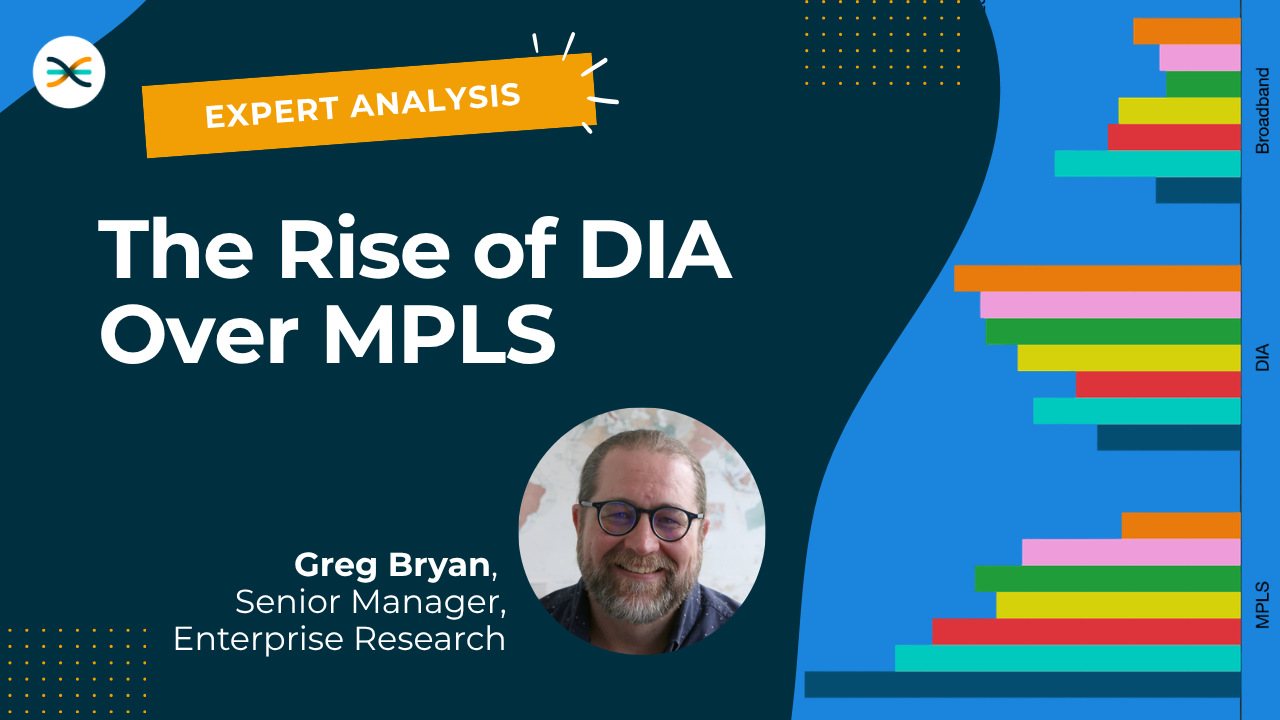
Usage dropped sharply from 82% of respondent sites in 2018 to just 22%. While MPLS remains necessary for specific geographies (such as China and Africa) and legacy data centers, it is no longer the central option around which networks are built.
Dedicated Internet Access (DIA) expanded from 27% in 2018 to 54% of sites, solidifying its place as the primary underlay option. Nearly 95% to 96% of surveyed enterprises run DIA somewhere in their network.
Despite business broadband offering cost savings, enterprises still lean heavily on DIA due to strict carrier-grade SLAs, high reliability, and uncontended bandwidth requirements.
Contrary to market hype, AI and Generative AI are not yet significant drivers of enterprise bandwidth growth. Between a quarter and a third of surveyed managers stated AI was not impactful to their bandwidth needs.
Most enterprises currently utilize AI for simple text prompts rather than automated, bandwidth-heavy application loops or localized model training.
Cloud resources and Software as a Service (SaaS) applications remain the primary engines driving bandwidth expansion and port upgrades up to the 10-Gig range.
Approximately 63% of enterprises have deployed SD-WAN. While deployment times still average about a year, a growing minority (~12%) are choosing to bypass SD-WAN entirely as network topologies shift toward edge security.
SASE implementation has reached 53%. Within security architectures, Zero Trust Network Access (ZTNA) reached 79% adoption, effectively replacing traditional IP connections.
Managed SD-WAN accounts for 56% of deployments. Smaller IT teams lean heavily on managed or co-managed solutions, while larger teams tend to insource network management.
About 44% of respondents run satellite connectivity at more than 5% of their sites. Low Earth Orbit (LEO) options like Starlink are primarily leveraged for hard-to-reach locations (such as agriculture or remote industrial sites) or as secondary backup links.
Network as a Service (NaaS) adoption remains flat between 15% and 17%. While interest exists for seasonal bandwidth scaling and unified performance monitoring, broad enterprise implementation remains limited.
Enterprise network engineering is moving away from rigid, single-vendor setups toward a hybrid model prioritizing flexibility, direct internet access, and cloud-first security. As bandwidth costs decrease and automated tools like AI Ops mature, WAN managers will continue balancing connectivity performance with integrated security models.
Aug 6, 2019
My wife has a brutal Northern Virginia commute; she drives about 80 miles a day. Recently, we decided it...
Aug 25, 2026
Over the past decade, multiple forces have converged to push enterprises to rethink how they connect...
Oct 18, 2019
In house or outsourced? This is an age-old question for many firms. If you’re a big economics nerd like...