Blog
Jun 29, 2026
AI’s Impact on Data Center Deployments and Operations
Every AI query, every model training run, every real-time inference request has to happen somewhere....

Everyone knows what a data center is (or at least has a general idea). This very fact is a result of a seismic shift in public engagement with the network infrastructure market.
Years ago, people generally had the vague notion that our data lives in a cloud somewhere, and now, in last week's U.S. midterm elections, data storage facilities seemed about as popular as power lines. A CNBC headline summed it up: “Voters rebuff data centers in every ballot measure except one.”
So what does growing anti-data-center sentiment mean for the future of data centers? Will data center construction in the U.S. grind to a halt?
We matched the related election results to each planned and pre-construction site in TeleGeography’s Data Center and Interconnection Research Service. As it turns out, the effect may be less than the news headlines indicate—well, except for in Texas. We’ll get to that in a minute.
First, by way of background, two levels of governance most directly affect U.S. data center development—the state and the local level. States shape environmental permitting, tax incentives for investment, and access to the power grid. Governors (of whom 36 were elected last week) guide this direction along with state legislators. The next level is local government. This involves both county and city-level jurisdiction. Counties, cities, towns, and townships generally govern specific zoning regulations.
Let’s look at what happened on the state level first. Take a look at the accompanying table.
What Changes at the State Level
| State | Governor(-Elect) | What They've Promised | Status |
| Texas |
Gina Hinojosa (D), unseated incumbent |
"A moratorium—a ban—on all data center approvals" until the legislature passes new protections; end sales-tax breaks |
Outgoing governor's grid and permit freezes already in force |
| Ohio |
Amy Acton (D) |
Conditional moratorium: developers must cover their utility costs, use union labor, meet environmental standards, and build on old industrial sites |
Pledge; Republican legislature |
| Georgia |
Keisha Lance Bottoms (D) |
Temporary statewide pause on new data center approvals while impacts are studied |
Pledge; length not set |
| Maine |
Hannah Pingree (D) |
Statewide moratorium on large data centers "on day one" until safeguards are in place (Gov. Mills vetoed one in April) |
Pledge; Democratic legislature |
| Kansas |
Cindy Holscher (D) vs. Ty Masterson (R) |
Holscher pledged a statewide moratorium |
Not called as of Nov 10; Holscher leads, close-race audit under way |
| New York |
Kathy Hochul (D), re-elected |
Existing one-year pause on permits for new sites of 50 MW or more |
In force since July |
| Pennsylvania |
Josh Shapiro (D), re-elected |
Developers must "build, bring or buy" their own power and pay its full cost |
Cost rule, not a pause |
| Iowa, Michigan, Wisconsin, Oregon |
Rob Sand, Jocelyn Benson, David Crowley, Tina Kotek (all D) |
Ratepayer protections, grid-cost and labor conditions; Oregon supports local moratoriums |
Cost rules, not pauses |
Notes: Results unofficial as of Nov 10, 2026. Governors-elect take office in January (Maine Jan 6; Ohio and Georgia Jan 11; Texas Jan 19). Sources: Texas Tribune; Fortune; CNBC; Maine Public; Kansas Secretary of State via local reporting; MultiState.
The biggest story by far is Texas, which, by our estimates, accounts for more than 15% of all planned data centers in the U.S. The recent claim that grid access requests in Texas exceeded ERCOT capacity by five times was enough to put a freeze on new site development pending a utility audit. The newly elected administration there has pledged to go even further, extending a moratorium until new legislative controls are passed. In Ohio, where about 7% of the U.S. data center pipeline is concentrated, the new administration has pledged to push for a conditional moratorium, exempting developers who agree to pursue brownfield rather than greenfield development along with other criteria.
A couple of key takeaways here shed light on the effect of state elections on data center development.
Now let’s take a look at local voting results on data centers.
Local Restrictions Approved on November 3
| Place | State | What Voters Approved |
|
Granville, Hubbard, Upper Sandusky |
Ohio |
Bans on all data centers |
|
Conneaut, Defiance, Oregon, Pataskala, Piqua, Sunbury, Trenton |
Ohio |
Bans on data centers over 25 MW |
|
Urbana |
Ohio |
Ban on data centers over 7.5 MW |
|
Grove City |
Ohio |
Public vote required for projects of 50+ acres, over 20 MW, or using over 500,000 gallons of water a day |
|
Monroe Township, Sprigg Township |
Ohio |
Zoning review required for "higher-impact development" |
|
Perry |
Ohio |
Financial guarantees from large developers seeking tax breaks |
|
Wilmington |
Ohio |
Four rezonings for industrial use rejected |
|
Ashville |
Ohio |
Village's development deal with a data center operator rejected |
|
Alhambra |
California |
Ban |
|
Edgewater |
Florida |
Ban on new data centers |
|
El Dorado, Emporia |
Kansas |
Bans on "high-impact" data centers (El Dorado's for 10 years) |
|
Ottawa |
Kansas |
Ban on data centers over 25 MW |
|
North Berwick |
Maine |
Ban on data centers of 25,000 sq ft or more |
|
Brownfield, Eliot, Freedom, Peru, Sabattus, Wells, Wiscasset |
Maine |
Temporary moratoriums (most for 180 days) |
|
Janesville |
Wisconsin |
Public vote required before a major former-factory site is developed |
|
Boulder City |
Nevada |
Voters rejected allowing data centers on city land (about 71% against) |
Notes: Results unofficial as of Nov 10, 2026. Seven advisory (non-binding) votes in Illinois, one in New Jersey and one in Monroeville, Ohio also went against data centers. Brownfield, Eliot, Freedom and Sabattus (Maine) are reported by Maine media but are not in Ballotpedia's count of 41 measures. Sources: Ballotpedia; GridSight; The Ohio Newsroom; Maine Public; local reporting.
Ballotpedia indicates that 41 data center measures made the local ballot in 10 states, and voters opposed data centers in 40 of those measures. That sure sounds like an overwhelming result. But is it? Indeed, several of these votes were a direct rebuke of significant projects, particularly in Piqua, Ashville, and Wilmington—all in Ohio. But only about 30% of the votes were in response to a specific named project. And more crucially, local bans stop within city limits. This exempts a vast majority of developments from restrictions.
So let’s bring this back to the big question: How much will last week’s midterms affect the U.S. data center development timeline?
Bringing TeleGeography’s U.S. site data to bear in the accompanying map, we include nearly 900 U.S. sites that are either in the near-term pipeline or in some further stage of pre-construction. Levels of development restriction are shown at a state level according to the categories in the legend.
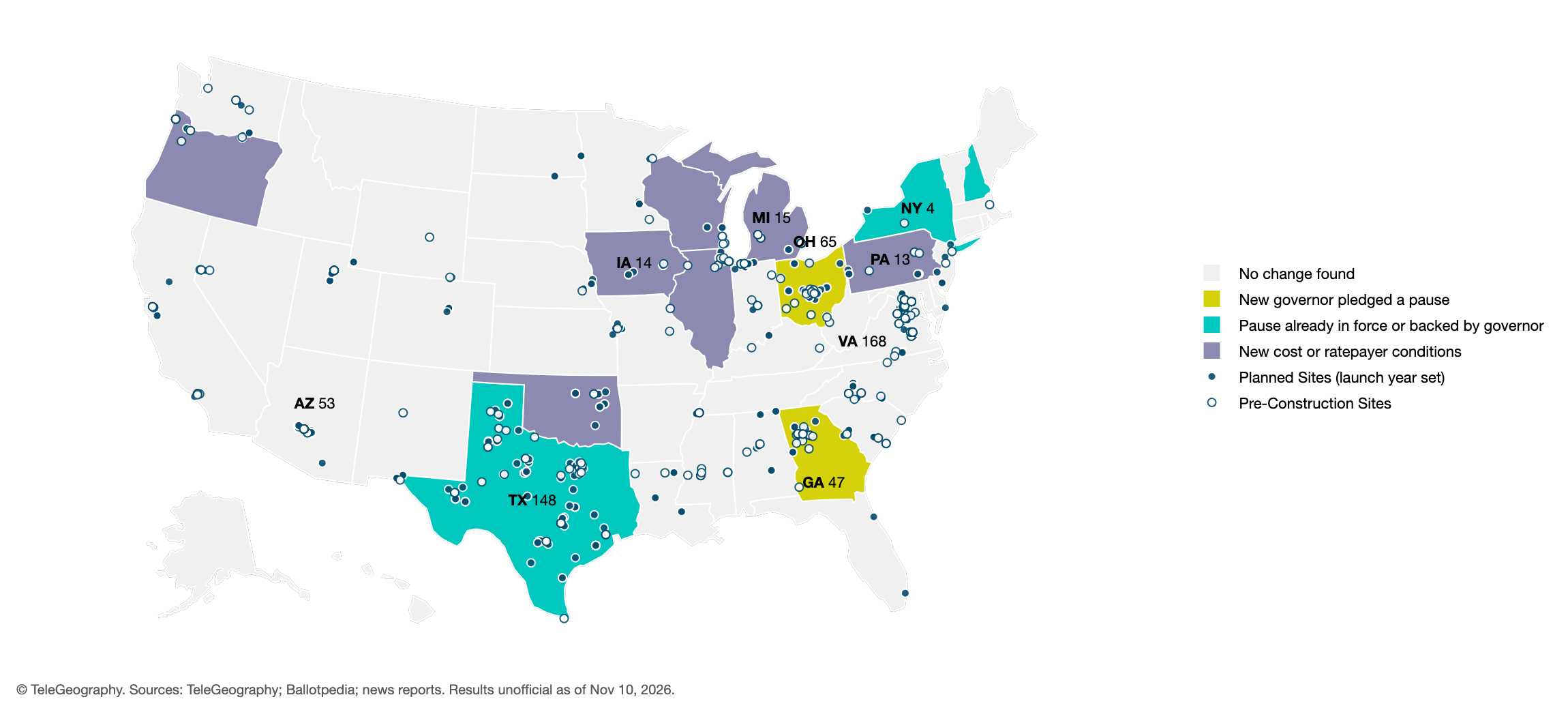
What does this show? Around 55% of sites are in places with no existing or pending restrictions. Another 15% could be affected by ratepayer protection policies but not development pauses. This leaves 30% of sites in jurisdictions with an existing or pledged pause. And there’s even a caveat there. Projects underway are far less likely to be affected by new or recent moratoria. New approvals will be much harder hit. And what about local voting results? Yes, there will be high-profile cases where ballot initiatives pause or completely shut down local projects, but these will be isolated responses.
What we’re seeing now in the U.S. is already quite familiar to our readers in Europe and Asia. Some of the highest-profile markets in the world, like Singapore, Amsterdam, and Frankfurt, have moved from concerns about the sustainability of the pace of data center development, to moratoria, to new policies. Here are a few ways this has played out.
We can expect similar patterns of adaptation between government authorities and data center developers in the U.S. Here’s what we expect to play out in the near term:
Get industry-leading data on the global data center market with our Data Center and Interconnection Research Service. We track nearly 7,000 operating data centers in 116 countries, plus more than 1,700 sites that are planned or in pre-construction. We collect and analyze the telecom industry's most comprehensive intelligence on data center capacity, service providers, pricing trends, and more.

Jun 29, 2026
Every AI query, every model training run, every real-time inference request has to happen somewhere....
Dec 4, 2023
Recently, we’ve been closely monitoring the intensifying pressures of insatiable demand and supply...
Dec 11, 2023
By our 2023 estimates, the Washington metropolitan area—or more specifically Northern Virginia...