
Blog
Feb 6, 2026
How Do Wholesale Carriers Fit In the Global Traffic Picture?
Broadly speaking, telecom service providers have two ways of connecting traffic to a destination telco....

Our IP Networks Research Service—which recently underwent its big annual update—includes an analysis that explores how, what, and where internet backbone providers connect.
Continue reading for a sample of our 2025 provider rankings, which compare and assess which internet providers have the most extensive network of connections to other companies.
Our rankings of provider connectivity include analysis based on BGP routing tables, which govern how packets are delivered to their destinations across myriad networks as defined by autonomous system numbers (ASNs).
Every network must rely on other networks to reach parts of the internet that it does not itself serve; there is no such thing as a ubiquitous internet backbone provider.
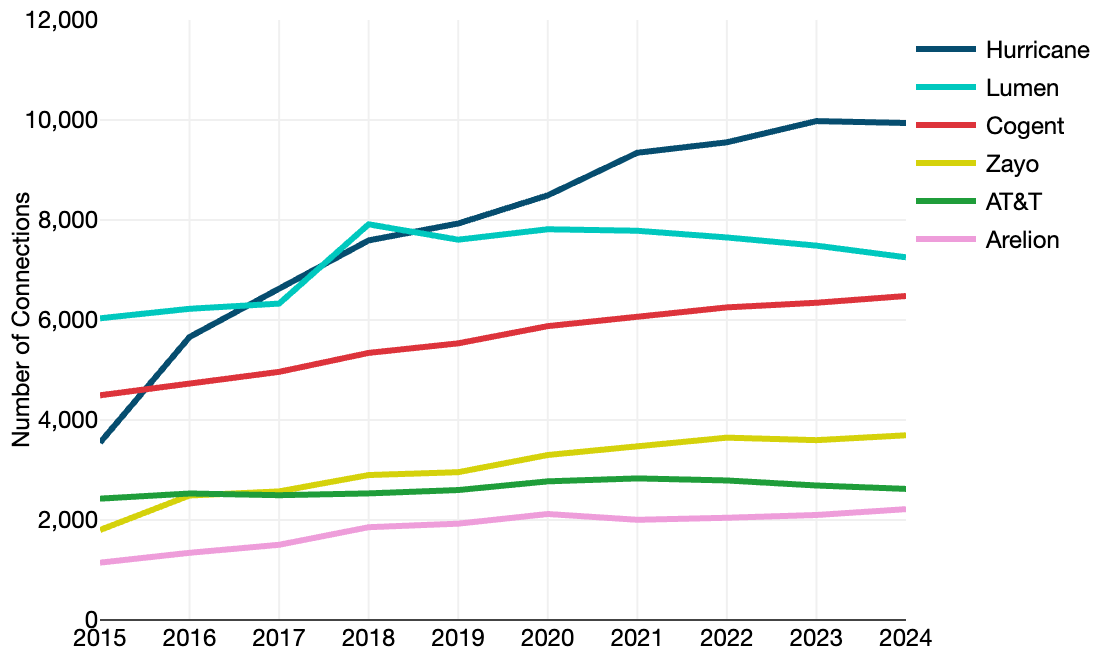
If you want a single, simple number to identify the best-connected provider in the world, you may come away disappointed. There are several ways to measure connectivity, and each highlights different strengths and weaknesses of a provider’s presence. One basic metric is to count the number of unique Autonomous Systems (AS) to which a backbone provider connects, while filtering out internal company connections. The results are presented in the table below.
Hurricane Electric has experienced consistent gains and now ranks as the clear number one in terms of connections. Cogent has also experienced steady growth. Lumen and Hurricane Electric had swapped the top spot back and forth for several years.
Lumen (formerly CenturyLink) experienced significant gains a few years ago when the company acquired Level3. Since then, the number of ASNs connected to Lumen has stagnated.
In addition to examining the overall number of connections, we also used our analysis of BGP routing tables to look at the “reach” (a measure of the number of IP addresses an upstream ASN has been given access to from downstream ASNs) and "share" (which compares an upstream provider’s reach to all other upstream providers of a downstream ASN.)
The results of this analysis paint a different picture.
In some cases, an ISP might end up high-ranked in terms of the number of connections, but lower-ranked in terms of share or reach when the number of IP addresses passed from its customers is relatively small.
IP Networks Research Service subscribers get access to this deeper analysis.

Feb 6, 2026
Broadly speaking, telecom service providers have two ways of connecting traffic to a destination telco....
Feb 7, 2023
Feb 3, 2025
If you’ve checked out our International Voice Report, you probably noticed that the data carefully...