---
title: "Most Connected & Fastest Growing Cities: Market Connectivity Score, H1 2026"
description: See the most connected and fastest growing cities for internet infrastructure with TeleGeography's Market Connectivity Score.
image: https://resources.telegeography.com/hubfs/Market%20Connectivity%20Score%20(1).png
---
[](https://www2.telegeography.com/)
- [About](https://www2.telegeography.com/about-us)
- [Research](https://www2.telegeography.com/our-research)
- [Products](https://www2.telegeography.com/products)
- [Solutions](https://www2.telegeography.com/solutions)
- [Resources](https://resources.telegeography.com)
[Log In](https://www.telegeography.com/login/login?service=https%3A%2F%2Fwww.telegeography.com%2Faccount%2Fhome%2Findex)
[Contact](https://www2.telegeography.com/contact-us)
###### Data and Analysis Tools
- [Cloud and WAN Research Service](https://www2.telegeography.com/cloud-and-wan-infrastructure)
- [Data Center Research Service](https://www2.telegeography.com/data-center-research-service)
- [GlobalComms Database](https://www2.telegeography.com/globalcomms-database-service)
- [International Voice Report](https://www2.telegeography.com/telegeography-report-and-database)
- [IP Networks Research Service](https://www2.telegeography.com/ip-networks-research-service)
- [ISP Navigator](https://www2.telegeography.com/isp-navigatorisp-navigator)
- [Transport Networks Research Service](https://www2.telegeography.com/transport-networks)
- [Network Pricing Database](https://www2.telegeography.com/telegeography-pricing-database)
- [WAN Cost Benchmark](https://www2.telegeography.com/wan-cost-benchmark)
- [Product Passes](https://www2.telegeography.com/product-passes)
###### Consulting
- [All Consulting Services](https://www2.telegeography.com/consulting)
- [Submarine Cable Consulting](https://www2.telegeography.com/submarine-cable-consulting)
###### Maps
- [All Map Services](https://www2.telegeography.com/map-services)
- [Sponsor a Map](https://www2.telegeography.com/sponsor-a-map)
- [License Map Data](https://www2.telegeography.com/license-geocoded-map-data)
- [Cite a Map](https://www2.telegeography.com/cite-telegeography-map)
- [Buy a Map](https://shop.telegeography.com/collections/telecom-maps/)
###### Industry
- [Enterprise](https://www2.telegeography.com/enterprise)
- [Tech](https://www2.telegeography.com/tech)
- [Telecom](https://www2.telegeography.com/telecom)
###### Case Studies
- [AI + Retail Telecom Data](https://www2.telegeography.com/where-to-get-global-telecom-data)
- [EXA Infrastructure](https://www2.telegeography.com/exa-infrastructure-case-study)
- [Orange Wholesale](https://www2.telegeography.com/orange-wholesale-case-study)
- [The European Commission](https://www2.telegeography.com/the-european-commissions-data-backed-approach-to-international-policy)
[Back to Resources](https://resources.telegeography.com)
# Most Connected & Fastest Growing Cities: Market Connectivity Score, H1 2026
##### By [Jon Hjembo,](https://resources.telegeography.com/author/jon-hjembo) Mar 04, 2026
[Networks](https://resources.telegeography.com/tag/networks) [Data Centers](https://resources.telegeography.com/tag/data-centers)
Which cities are the most connected, and which ones are the fastest growing for internet infrastructure? Which cities are best poised to support AI?
Twice a year, we make public our assessment of the top 10 most connected and fastest-growing cities with our [Market Connectivity Score](https://www2.telegeography.com/market-connectivity-score)—an interactive tool in our [Data Center Research Service](https://www2.telegeography.com/data-center-research-service). The Market Connectivity Score tracks 45 different data points for every city, including:
- Data center power,
- Number of ASNs peering locally,
- Cloud onramps, and more.
And those data points create scores in each category for cities on a scale of 0-100. So without further ado, here are the most connected and fastest growing cities for H1 2026.
## Most connected cities: H1 2026
1. London | 60.7
2. Frankfurt | 60.1
3. Tokyo | 58.6
4. Singapore | 54.8
5. Amsterdam | 54.6
6. Washington, DC | 52.6
7. New York | 52.5
8. Hong Kong | 51.2
9. Paris | 50.7
10. Los Angeles, CA | 47.6
### Most connected cities, 2026 vs. 2025
Compared with the previous year’s list of most connected cities in the world, 2026 was a remix. The top 10 cities remained the same, with a reshuffling of:
- London (2 to 1) and Frankfurt (1 to 2)
- Singapore (5 to 4) and Amsterdam (4 to 5)
- Washington (8 to 6), New York (6 to 7), and Hong Kong (7 to 8).
Tokyo (3), Paris (9), and Los Angeles (10) held their ranks from 2025 to 2026.
| **Most Connected Cities - TeleGeography’s Market Connectivity Score** | | |
| --- | --- | --- |
| **Ranking** | **H1 2026** | **H2 2025** |
| 1 | London | Frankfurt |
| 2 | Frankfurt | London |
| 3 | Tokyo | Tokyo |
| 4 | Singapore | Amsterdam |
| 5 | Amsterdam | Singapore |
| 6 | Washington, DC | New York |
| 7 | New York | Hong Kong |
| 8 | Hong Kong | Washington, DC |
| 9 | Paris | Paris |
| 10 | Los Angeles | Los Angeles |
## Fastest growing cities: H1 2026
The fastest-growing cities rankings are based on the future growth score—also measured on a scale of 1-100—of the top 200 most connected metro areas.
1. Hong Kong | 34.3
2. Manila | 33.7
3. Columbus, Ohio | 28.1
4. Hangzhou | 27.7
5. Shenzhen | 27.6
6. Singapore | 27.1
7. Cairo | 25.0
8. Daegu | 23.4
9. Washington, DC | 23.2
10. Dallas, TX | 22.6
### Fastest growing cities, 2026 vs. 2025
Compared with the 2025 fastest growing cities rankings, the 2026 list has a few surprises.
#### Columbus, Ohio
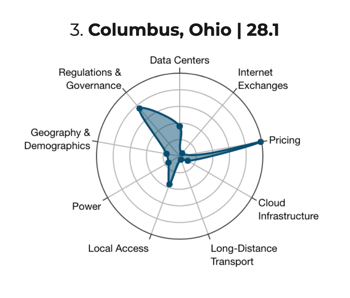
Columbus, Ohio is making its debut on this list at number three, thanks to its high scores in data categories for pricing, regulations and governance, data centers, and local access. (You can read more about how we create these scores below.) Several wholesale commercial data center operators are expanding across the metro along with significant hyperscale campus expansions. New development is happening across New Albany, Hilliard, Columbus, Lancaster, Hebron, Jersey Township, and other nearby towns. Much of this new development is using on-site gas conversion and other "behind the meter" power systems.
#### Dallas, TX
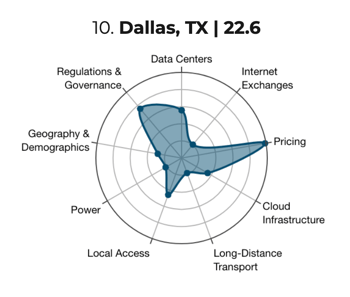
Another newcomer on the fastest growing cities list is Dallas, TX, coming in at number 10. Dallas scores highly in data categories for pricing, regulations and governance, data centers, local access, and cloud infrastructure. The Dallas metro currently has more than a dozen major commercial data centers in the near pipeline.
#### Kuala Lumpur
One major upset is Kuala Lumpur falling from the top 10 list. Formerly scoring in first place as the fastest growing city, Kuala Lumpur's planned cloud regions [caught our attention last year](https://resources.telegeography.com/data-gravity-top-internet-connectivity-markets). But as we discuss below, Market Connectivity Scores are multifaceted and calculated according to nine categories of data, pulling data from multiple [TeleGeography products](https://www2.telegeography.com/products). With all of those inputs, there is room for surprises as market developments around the world take shape.
Kuala Lumpur has experienced a lot of development in the last few years. Now, Malaysia is facing constraints that other markets have already seen, curtailing further near-term development. Malaysia has, in fact, announced that it is no longer approving non-AI data center development due to power and water constraints, and this has contributed to Kuala Lumpur ranking in the lower fifth of our top 200 fast-growth markets for planned power development.
| **Fastest Growing Cities - TeleGeography’s Market Connectivity Score** | | |
| --- | --- | --- |
| **Ranking** | **H1 2026** | **H2 2025** |
| 1 | Hong Kong | Kuala Lumpur |
| 2 | Manila | Hong Kong |
| 3 | Columbus, Ohio | Manila |
| 4 | Hangzhou | Frankfurt |
| 5 | Shenzhen | Shenzhen |
| 6 | Singapore | Hangzhou |
| 7 | Cairo | Singapore |
| 8 | Daegu | Taipei |
| 9 | Washington, DC | Jakarta |
| 10 | Dallas, TX | Cairo |
## Where you can get this data
These rankings of the 10 most connected and fastest growing cities are fueled by TeleGeography's [Data Center Research Service](https://www2.telegeography.com/data-center-research-service)—the most comprehensive source of intelligence on data center infrastructure and ecosystems. With the Data Center Research Service, you can:
- Access our [Market Connectivity Score](https://www2.telegeography.com/market-connectivity-score), a powerful tool that measures current and potential data center size for 3,000 cities worldwide
- Explore an interactive map depicting nearly 6,400 active data centers
- Discover where to access different networks, internet exchanges, or cloud providers
- View data center site profiles, including operator contact details, megawatt capacity, floor space, and vital details about the site ecosystem
- Get expert analysis of global data center market trends compiled from over 1,000 site surveys and supplemental research
- Access current and historical colocation pricing data for top global markets.
## How the Market Connectivity Score works
In brief: the MCS is a tool to compare and summarize market development which can be specifically tailored to your priorities. It calculates a score for each market by averaging its relative sub-scores. These are drawn from the data categories described below. At any time, you may hit the "change weights" button, which lets you adjust how important each category is to calculating the final score.
After all, there's no single answer to which market is the "best." Context is critical. Don't care about internet exchanges? Change their weight to zero. Need access to cloud infrastructure? Boost its weight to the maximum. The scores will adjust accordingly, showing the most important markets for your situation.
### Data categories
The MCS analyzes nine broad categories of data, seven of which are derived directly from TeleGeography datasets. Interestingly, these indicators pull not only from the Data Center Research Service, but other [TeleGeography products](https://www2.telegeography.com/products) as well. Here, we'll provide a brief summary of each category, its source, and how it impacts Market Connectivity Scores:
#### Data centers
This data group tells us how a market fares when it comes to provisioning data center infrastructure in support of the local communications market. It’s all about data center capacity in deployment and in the pipeline. Pulling from our extensive [Data Center Research Service](https://www2.telegeography.com/data-center-research-service), the overall data center score is derived from aggregate market capacity in place, numbers of sites, and sites in deployment.
One of the sub-categories here is "Data Centers Planned." The scoring here specifically tracks new data center sites that are actively in deployment. It doesn't include expansions to existing facilities or land bank purchases; just where new buildings are under construction and due to launch within the next few years.
#### Internet exchanges
Internet Exchange (IX) presence and activity is a great indicator of communications market health, and one we research in the Data Center Research Service. Scores for ASNs connected and the number of IXs in the market tell us how many networks and platforms are present. These scores also let us know whether the local market is overly dependent on an incumbent operator. More networks at more peering locations indicates greater local competitiveness. One other measure in this category is the percentage of ASNs that are international. This provides an early indication of whether international carriers see the market as a valuable place to deploy.
#### Pricing
Pulling from our [Network Pricing Database](https://www2.telegeography.com/telegeography-pricing-database) this data group gives a fundamental indicator of the cost of connecting in a market. Low scores indicate higher costs, which increase barriers to market entry and activity.
#### Cloud infrastructure
This score category pulls from a number of data sets in our [Cloud and WAN Infrastructure Service](https://www2.telegeography.com/cloud-and-wan-infrastructure). It tells us the extent to which cloud applications can be delivered locally. Customers access cloud services via onramps, which then give them dedicated access to platforms stored either in massive cloud zone data center constellations or in smaller local cloud zones with more limited offerings. We track all of these here. We also include CDNs in this list—the caches that allow content to be delivered locally.
Within this broader data group, we track cloud regions planned. This indicator tracks announced, but not yet operational, cloud regions. Some have much longer lag times to deployment than others.
#### Long-distance transport
Several TeleGeography metrics are tied into this broad category. International internet capacity and count of directly connected cities are pulled from our [IP Networks](https://www2.telegeography.com/ip-networks-research-service) research. These are great indicators of how well a given market is integrated into global networks. In some cases, this measure enforces, along with data center development, the growing or continuing significance of a market. In other cases, it may remind us that a market still has significance as a network hub despite slower growth in data center rollouts.
Next, existing and planned submarine cables are tracked in our [Transport Networks](https://www2.telegeography.com/transport-networks) research. The number of active and planned subsea cables further enforce a market’s place on wider intra-regional or intercontinental stages. Of course, landlocked cities have no use for subsea metrics, but the last components in this category—numbers of long-haul and WAN carriers present from our [Cloud and WAN Infrastructure Service](https://www2.telegeography.com/cloud-and-wan-infrastructure)—make up the difference. Here we can see how robust the competition is for access to the outside world—both for local carriers and for enterprises.
#### Local access
This network-specific data group shows us how big the fixed broadband market is and how much of the mobile market has broadband-level access. Even if the peering and transport infrastructure is lacking in a given location, high broadband usage is a clear indicator of need for network support infrastructure. This data is drawn largely from TeleGeography's [GlobalComms Database](https://www2.telegeography.com/en/globalcomms-database-service).
#### Power
In today’s connectivity markets, no commodity is more precious than power. Many of the world’s most critical communication hubs are suffering from a full-blown crisis in lack of electricity to support data center, cloud, and network needs. This crisis comes at a time when governments around the world are pushing to reduce dependence on fossil fuels and increase usage of clean power, which is even more scarce. This data group in the MCS uses data from the [Global Energy Monitor](https://globalenergymonitor.org/) to rank cities by their current and planned availability of clean power.
#### Geography & demographics
This category provides larger macro indicators for each city that indicate relative potential for communications market development. Most of the individual measures here come directly from TeleGeography, with the exception of [Global 5000 Database](https://theglobal5000.com/) data, which shows us the number of major corporations with headquarters in a given city. One of the metrics here gives an intriguing view of how relatively a given city is pulled into the orbit of or independent from other hubs. The measure, "Remoteness from Other Hubs" tells us how the city’s Long-Distance Transport score compares to other cities in a 100-km radius.
#### Regulations & governance
This final category is derived from the World Bank's [Worldwide Governance Indicators](https://www.worldbank.org/en/publication/worldwide-governance-indicators). It provides a sense of how volatile or dependable a local operating environment may be by measuring rule of law, regulation, stability, and freedom of voice.
[](https://resources.telegeography.com/hs/cta/wi/redirect?encryptedPayload=AVxigLIWCuQMIl2jqrYc70lSRgmxUugMdsAkYr3XR%2F%2Fy6P3QiS33chzvpv3%2BypxKrrgS9xrLBGCQOf3%2B%2FeQtXMnNUyG73TblMJKqgPDvaiLum92nr53qy4aoCUJrJqrQtfTGok0MLmK8fz5wen3KHqpG07HLVsuAOQ%2BZFg8xcaj2Sg8VM%2BdACg8ytqKdt8J3oWI2rhsJL6JIKSaZlFG7jRPzd7hGl%2BWN98rjdBJirarNV5bS&webInteractiveContentId=208657117791&portalId=594292)

#### Jon Hjembo
Senior Research Manager Jonathan Hjembo joined TeleGeography in 2009 and heads the company’s data center research, tracking capacity development and pricing trends in key global markets. He also specializes in research on international transport and internet infrastructure development, with a particular focus on Eastern Europe, and he maintains the dataset for TeleGeography’s website, internetexchangemap.com.
[View Jon Hjembo Work](https://resources.telegeography.com/author/jon-hjembo)
## Explore Related Content
###### Blog
Aug 5, 2026
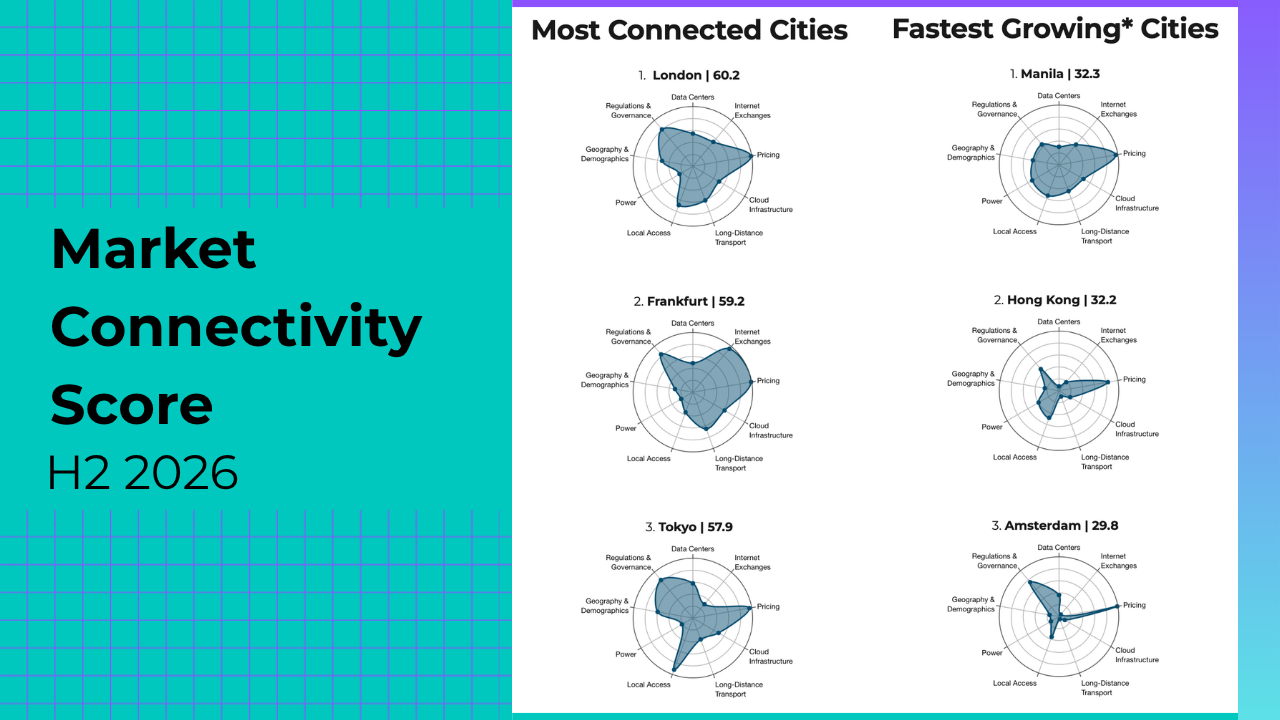
#### [Most Connected & Fastest Growing Cities: Market Connectivity Score, H2 2026](https://resources.telegeography.com/most-connected-fastest-growing-cities-market-connectivity-score-h2-2026)
Which cities are the most connected, and which ones are the fastest growing for internet infrastructure?...
[View More by Jon Hjembo](https://resources.telegeography.com/author/jon-hjembo)
[Read Full Article](https://resources.telegeography.com/most-connected-fastest-growing-cities-market-connectivity-score-h2-2026)
###### Blog
Aug 20, 2026
#### [Asia's Cloud Infrastructure Boom](https://resources.telegeography.com/asias-cloud-infrastructure-expansion)
Asia’s digital backbone is expanding at a staggering pace, quietly redrawing the global map of...
[View More by Patrick Christian](https://resources.telegeography.com/author/patrick-christian)
[Read Full Article](https://resources.telegeography.com/asias-cloud-infrastructure-expansion)

###### Blog
May 23, 2025
#### [How Data Gravity is Shaping Top Connectivity Markets](https://resources.telegeography.com/data-gravity-top-internet-connectivity-markets)
Which cities are the most connected, and which ones are the fastest growing for internet infrastructure?...
[View More by Jon Hjembo](https://resources.telegeography.com/author/jon-hjembo)
[Read Full Article](https://resources.telegeography.com/data-gravity-top-internet-connectivity-markets)
[](https://www2.telegeography.com/)
[Login](https://www.telegeography.com/login/login?service=https%3A%2F%2Fwww.telegeography.com%2Faccount%2Fhome%2Findex)
[Contact Us](https://www2.telegeography.com/contact-us)
###### [About](https://www2.telegeography.com/about-us)
- [Research](https://www2.telegeography.com/our-research)
- [Products](https://www2.telegeography.com/products)
- [Solutions](https://www2.telegeography.com/solutions)
- [Demo](https://www2.telegeography.com/demo)
###### [Press](https://www2.telegeography.com/telegeography-press)
- [Events](https://www2.telegeography.com/telecom-events)
- [Careers](https://www2.telegeography.com/careers)
###### [Resources](https://resources.telegeography.com/)
- [Podcast](https://www2.telegeography.com/telegeography-explains-the-internet-podcast)
- [Newsletter](https://www2.telegeography.com/subscribe-to-telegeography-emails)
-
-
All Rights Reserved 2026
- [Privacy Policy](https://www2.telegeography.com/privacy-policy)
```json
{
"@context" : "https://schema.org",
"@type" : "BlogPosting",
"author" : {
"@type" : "Person",
"name" : "Jon Hjembo",
"url" : "https://resources.telegeography.com/author/jon-hjembo"
},
"dateModified" : "2026-06-17T17:14:53.255Z",
"datePublished" : "2026-03-04T12:29:59.000Z",
"headline" : "Most Connected & Fastest Growing Cities: Market Connectivity Score, H1 2026",
"image" : [ "https://resources.telegeography.com/hubfs/Market%20Connectivity%20Score%20(1).png" ],
"mainEntityOfPage" : {
"@id" : "https://resources.telegeography.com/market-connectivity-score-h1-2026",
"@type" : "WebPage"
},
"publisher" : {
"@type" : "Organization",
"logo" : {
"@type" : "ImageObject",
"url" : "https://resources.telegeography.com/hubfs/assets/telegeography/telegeography-logo-blog.png"
},
"name" : "TeleGeography"
}
}
```
```json
{
"@context" : "https://schema.org/",
"@type" : "WebSite",
"image" : "https://www2.telegeography.com/hubfs/Website/assets/logo/telegeography-logo.svg",
"name" : "Most Connected & Fastest Growing Cities: Market Connectivity Score, H1 2026",
"potentialAction" : {
"@type" : "SearchAction",
"query-input" : "required name=search_term_string",
"target" : "{search_term_string}"
},
"url" : "https://resources.telegeography.com/market-connectivity-score-h1-2026"
}
```