
Blog
Dec 11, 2023
Where in the World Is the Largest Data Center Hub?
By our 2023 estimates, the Washington metropolitan area—or more specifically Northern Virginia...

What makes a city a hub? And what makes a hub healthy?
Before we answer these questions, we must acknowledge that the interconnection market is not a homogeneous thing. It's an ecosystem comprised of numerous critically interdependent parts, much like a body or a machine.
At TeleGeography, we have a unique take on what comprises the core elements of an interconnection ecosystem.
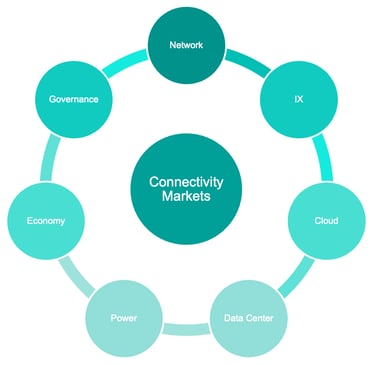
To make a strong interconnection market, the very basic thing is network—the local and global connectedness that holds everything together.
Then there’s the internet exchange (IX) platform—the traffic intersection for these networks to provision communications.
Cloud infrastructure delivers content and computing that enables us to do work over network ecosystems.
Data centers provide the housing, and power keeps everything running.
We also have to consider some macroeconomic factors, such as the economy itself, which generates traffic over the internet through personal and corporate communication activity.
Last, but not least, there is governance. Good governance provides the stability and transparency needed to enable an interconnection market to flourish.
These seven things—network, internet exchanges, cloud, data centers, power, economy, and governance—comprise a healthy interconnection ecosystem.
These seven things—network, internet exchanges, cloud, data centers, power, economy, and governance—comprise a healthy interconnection ecosystem.
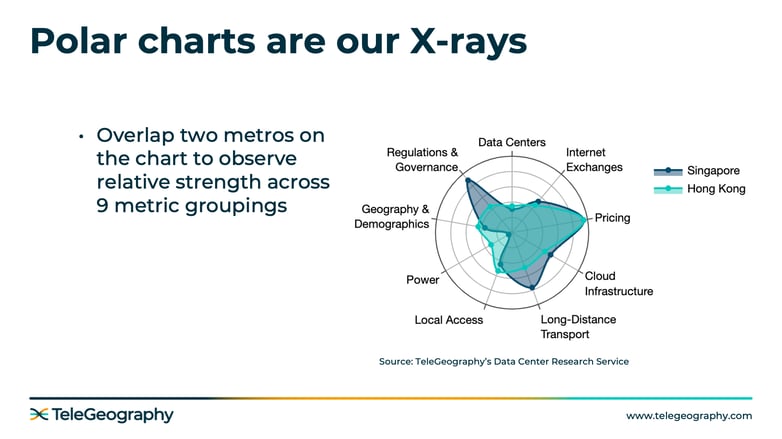
Now, let's discuss some specific, relative health comparisons using TeleGeography's new Market Connectivity Score (MCS). This tool captures 43 distinct market health metrics to help users diagnose the competitiveness of 3,000 global network and data center markets.
One of the visuals that we like to use is the polar chart, a fantastic way to overlap and compare two markets by their relative strengths and weaknesses.
Which markets should we compare?
Each of the eight cities listed below has a very healthy and growing data center market, with more than 1 million square feet of space in operation and more than 10% CAGR growth.
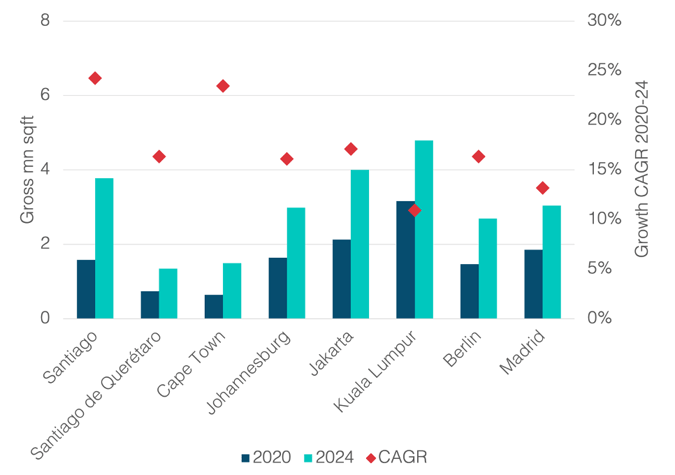
Let's do a series of side-by-side comparisons, starting with Jakarta and Kuala Lumpur 👇
This has been an excerpt of my PTC ’25 presentation. For more, you can download my full slide deck.
In this presentation, I look at impaired markets (markets with strong potential that lack key infrastructure), the lifeblood of any healthy market (power), and where we can find sources of clean energy moving forward.


Dec 11, 2023
By our 2023 estimates, the Washington metropolitan area—or more specifically Northern Virginia...
Nov 27, 2024
ICYMI: we recently launched a dynamic new tool called the Market Connectivity Score (MCS). The MCS is...
Jun 29, 2026
Every AI query, every model training run, every real-time inference request has to happen somewhere....


.png)