A steady stream of investment has driven tremendous growth in subsea cable infrastructure to keep pace with ever-increasing bandwidth demand.
According to new data from TeleGeography’s Transport Networks Research Service, the aggregate cost of new construction over the past nine years has averaged over $2 billion annually.
Let's take a look at the current state of submarine cable investment in 2026.
Meeting Demand Requirements in 2026
With the exception of a few anomalous years, we haven't seen this level of investment in subsea cable infrastructure since 2000-2001, and it's not letting up. The value of new submarine cables planned to enter service from 2026-2029 exceeds $16 billion.
Construction Cost of Submarine Cables
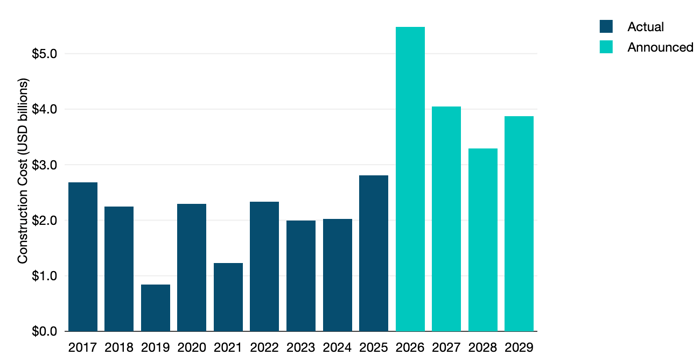
Notes: Total construction costs of all international and domestic submarine cables entering service in designated years. Construction costs exclude the cost of subsequent capacity upgrades and annual operational costs. Announced construction costs in light blue bars based on announced contract values and TeleGeography estimates. Not all planned cables may be constructed.Source: © 2026 TeleGeography
How is this substantial investment in subsea infrastructure being deployed regionally? In the past three years, Asia led investment with $2 billion in new cables, followed closely by trans-Pacific routes at $1.7 billion.
Look at the coming three years in the horizontal bar chart below. We see a significant surge in new cable investment across every route. The biggest surge by far is expected in Asia, where an aggregate of over $3.7 billion worth of announced new cables could enter service from 2026-2029.
The biggest surge is expected in the trans-Pacific, where multiple Google and Meta-led cables, along with several others, will drive an aggregate of over $3 billion in spending.
Construction Cost of New Submarine Cables Entering Service by Region
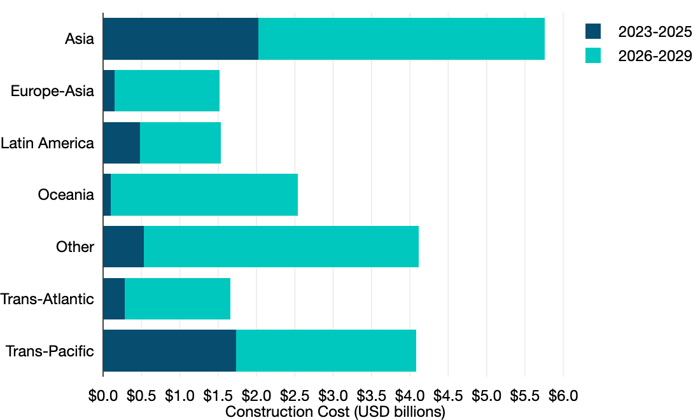 Notes: Construction costs based on the year the cable entered service. Construction costs exclude the cost of subsequent capacity upgrades and annual operating costs. Construction costs shown by light blue bars based on announced contract values and TeleGeography estimates. Not all planned cables may be constructed.
Source: © 2026 TeleGeography
Reasons for New Submarine Cables
There are numerous reasons for the surge in new cables around the world. Here are a few influential factors:
- Scarcity of potential capacity and fiber pairs. The most fundamental driver for new cable construction is the limited availability of potential capacity. On the surface, this issue may not appear important on major cable routes, where capacity utilization has only recently exceeded 50%. However, demand continues to rise steadily and could soon lead to capacity exhaustion without new cable investment.
- Ownership economics. Content providers are the largest users of bandwidth. As their scale rises on a route, they eventually become reluctant to lease wavelengths or purchase wavelength IRUs on existing cables. Instead, the content providers with the largest demand acquire capacity at cost by investing in new cables. They also seek to acquire large blocks of capacity in the form of fiber pairs or spectrum. As noted above, such massive blocks of capacity may be hard to come by on existing systems.
- Route diversity. Consumers of submarine cable capacity purchase bandwidth on multiple cable systems. Creating mesh networks is important to provide a high level of network availability.
- Reducing equipment costs. As their bandwidth requirements continue to surge, operators are concerned with the cost of adding capacity. By building new cables with massive capacities, network operators can achieve lower unit costs compared to lower-capacity legacy cables.
- Replacing aging cables. The need for new cables is also related to the expected retirement of aging cables. Cables are engineered to have a minimum design life of 25 years, but what really matters is the economic life. Oddly, a cable's economic life does not depend on a cable reaching its maximum capacity; a cable could see its end of economic life well before it has exhausted its capacity. The opposite is also true. Running out of upgradeable capacity does not mean immediate end of economic life, but it does signal that the cables may not have much longer useful life remaining.
Get more transport networks intelligence
Our Transport Networks Research Service delivers data and analysis on long-haul networks and the undersea cable market, with forecasts of international bandwidth supply, demand, prices, and revenues. Learn more and get research samples delivered to your email.