
Blog
May 28, 2024
Why Does Diversity Matter for Submarine Cables?
Last week, I joined Ciena’s Brian Lavallée and Colt’s Laurent Taieb for a live webinar all about...

“Submarine cables account for over 99% of intercontinental data traffic” is regularly quoted in the press with no source given.
It’s time for some fact-checking.
While digging into the origin of this myth, I was able to find one instance where a source was given. It was accredited to us, TeleGeography.
The citation linked to our Submarine Cable FAQs page, which states: “Statistics released by U.S. Federal Communications Commission indicate that satellites account for just 0.37% of all U.S. international capacity.”
We're only talking about U.S. international capacity here—not the total global capacity—and in relation to satellites.
I decided to go to the FCC’s website next.
Below, you’ll see a screenshot from the FCC’s Circuit Status Report page and a list of the reports that they offer.
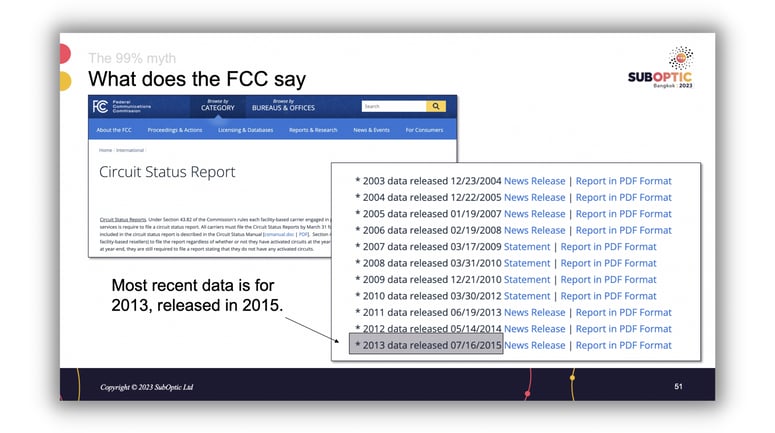
The most recent data is for 2013, released in 2015. It’s almost 10 years old now; not a great source.
There’s no new data because the FCC changed the reporting requirement and satellite operators don’t have to report their circuits anymore. So that’s a dead-end for us, unfortunately.
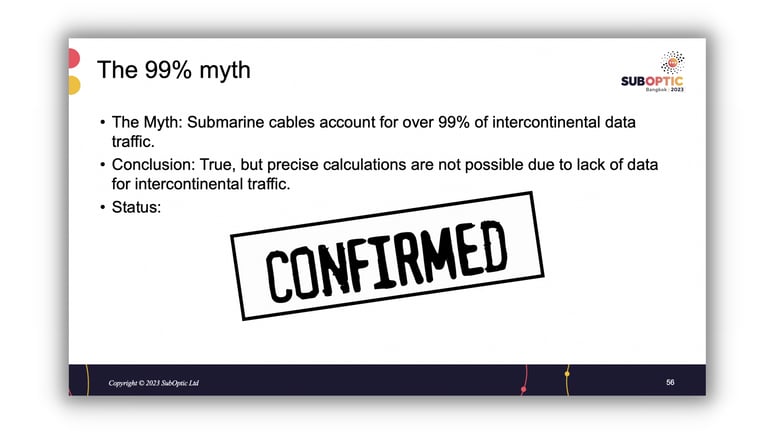
So, do submarine cables account for over 99% of intercontinental data traffic?
We can confirm that this is true. However, we can’t do precise calculations without data for intercontinental satellite traffic.
May 28, 2024
Last week, I joined Ciena’s Brian Lavallée and Colt’s Laurent Taieb for a live webinar all about...
Mar 13, 2026
The Strait of Hormuz is a crucial artery, not only for the transit of oil and cargo but also for the...
May 4, 2026
What's shaping the trajectory of the global bandwidth market? To answer that question, we identified...

.png)