
Video
Apr 6, 2023

“The lifespan of a submarine cable is 25 years.” We’ve all heard that, right?
Is this statement really a fact, or is it fiction? Let’s find out.
The origin of this myth is that submarine cables are engineered to have a minimum life of 25 years.
This refers to the wet plant components designed to have a specified failure rate during a 25-year period. It also refers to many warranties, permits, and landing licenses, which commonly expire after 25 years.
The economic life of a cable really depends on a system’s revenues, or economic value, exceeding its costs.
This point may be reached before or after a cable reaches its potential capacity—it varies by cable.
Some factors that influence a cable’s economic lifespan:
It’s important to note that cables may effectively reach their end of economic life but remain in service for reasons related to route diversity, corporate strategy, or national security.
Let’s look at some actual lifespans of cables in recent times. I created the chart below to show repeatered cables that have been retired since 2010.
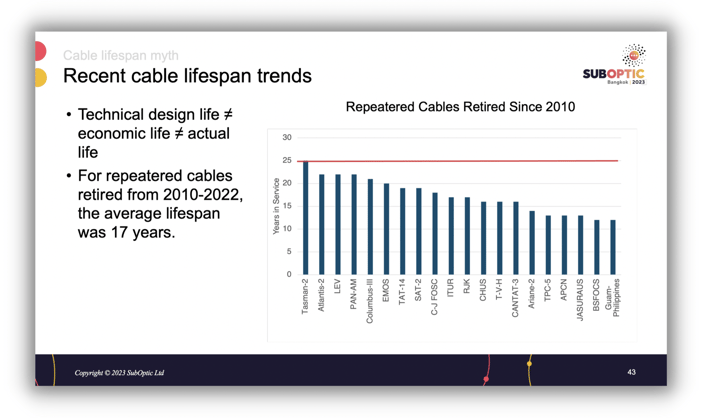
As you can see, they span from about 25 years in service to around 12 years. The average lifespan of the cables shown here is 17 years.
So we’re coming in well below the 25-year threshold—at least for cables retired in the last 12 years.
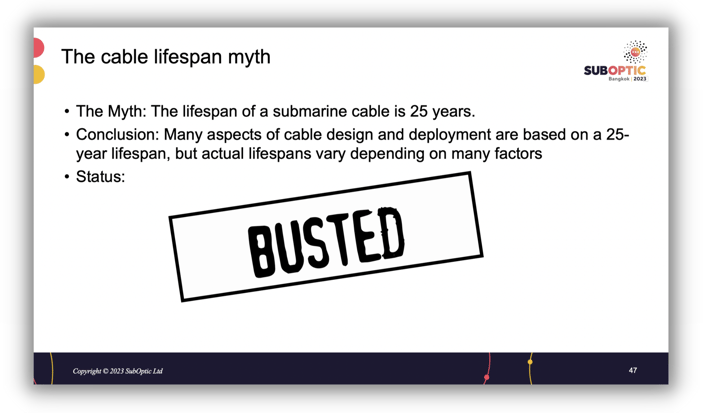
The data shows that cable lifespans vary a lot across a very wide range. So we can call this myth busted.
For more like this, download our latest mythbusters presentation slides.
Feb 29, 2024
Oct 2, 2025